Search Intent: The Most Important Lever in Google Ads
Search intent sits at the center of effective Google Ads. Learn how to target better keywords, filter poor clicks, and improve lead quality.
Google Ads performance rarely depends on budget alone. Two companies can spend the same amount and receive completely different results. The difference often comes down to search intent.
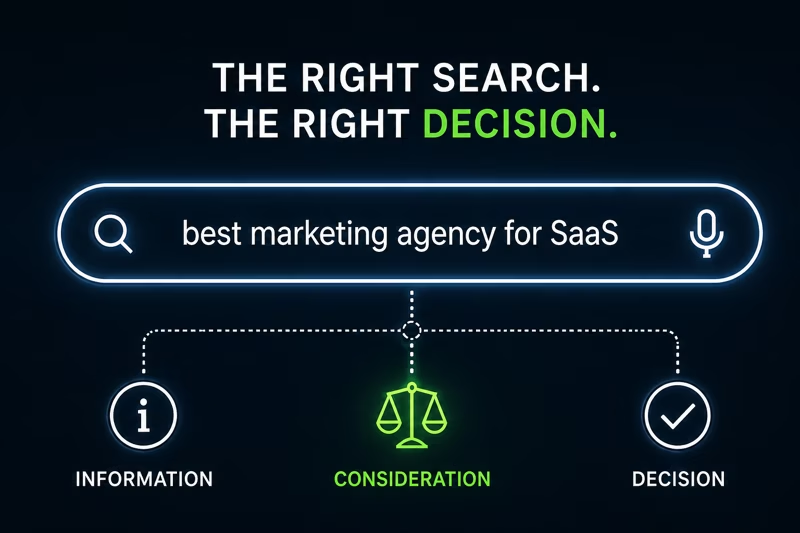
Search intent is what a person is really trying to accomplish when they type a query into Google. They may want to learn, compare, buy, request a quote, find a provider, or solve an urgent problem. Understanding that intent is essential for generating qualified leads.
Not all searches have the same value
A common mistake is treating all searches as if they carry the same value. Some searches indicate an immediate need. Others only show curiosity.
Searches such as “commercial cleaning service price,” “how to do commercial cleaning yourself,” “best commercial cleaning company,” “commercial cleaning jobs,” and “commercial cleaning training” can use similar words, but the intent is completely different. Google Ads becomes more profitable when budget is concentrated on searches closest to a business opportunity.
Keywords are not enough
A keyword is an entry point, not a guarantee. Depending on match types, a campaign can appear for many variants. Some will be useful, and others will not.
That is why real search terms need to be reviewed. The search terms report shows the queries that actually triggered ads. It reveals new keyword opportunities, useless searches, weak intent, negative keyword needs, and language that converts better.
Google Ads management is not only about choosing keywords. It is about controlling the intent the account is buying.
Negative keywords protect the budget
Negative keywords are often underestimated. They are essential for reducing wasted clicks because they stop ads from showing on searches that do not match the offer.
- free
- jobs
- training
- DIY
- definition
- example
- cheap
- used
- services the business does not offer
Intent should guide account structure
Strong Google Ads structure separates intent. Campaigns or ad groups should not group too many different searches together. When they do, ads become generic and data becomes difficult to interpret.
An intent-based structure can separate urgent searches, quote searches, service-specific searches, regional searches, branded searches, competitor searches, and exploratory searches.
Ads should reflect the intent
If someone is looking for a quote, the ad should speak to requests, assessments, consultations, or getting in touch. If the person is searching for a specific service, the ad should mention that service. If the search includes a region, the ad should ideally reinforce local relevance.
Good ad copy answers the need expressed in the search. The better the alignment, the more likely the click is to be qualified.
Intent also influences bidding
High-intent searches can justify a higher cost per click. A very commercial search may be more expensive, but also much more profitable. A cheaper click is not necessarily a better deal if it comes from weak intent.
The goal is not to reduce cost per click at any cost. The goal is to pay for searches that are most likely to generate real opportunities.
Conclusion
Search intent is one of the most important levers in Google Ads. It influences keywords, ads, landing pages, bids, tracking, and lead quality.
A high-performing account does not simply try to appear on Google. It tries to appear at the right time, in front of the right people, with the right message. That precision is what turns Google Ads into a measurable growth channel.